
Compare the requested outcomes
A reduction may seek a lower offense level. A record-relief procedure may concern access or another legal effect defined by state law. Write down which result matters before choosing a route.
Check the order of applications
Where both routes exist, ask whether one affects the analysis of the other. Utah's court guidance discusses reduction in connection with later expungement questions. That relationship must be checked under the applicable state law.
Keep the evidence for each step
Use judgments, completion documents and later orders to build the review. After any change, confirm the official record before relying on it for another application.
A way to organize your review
Questions to keep separate
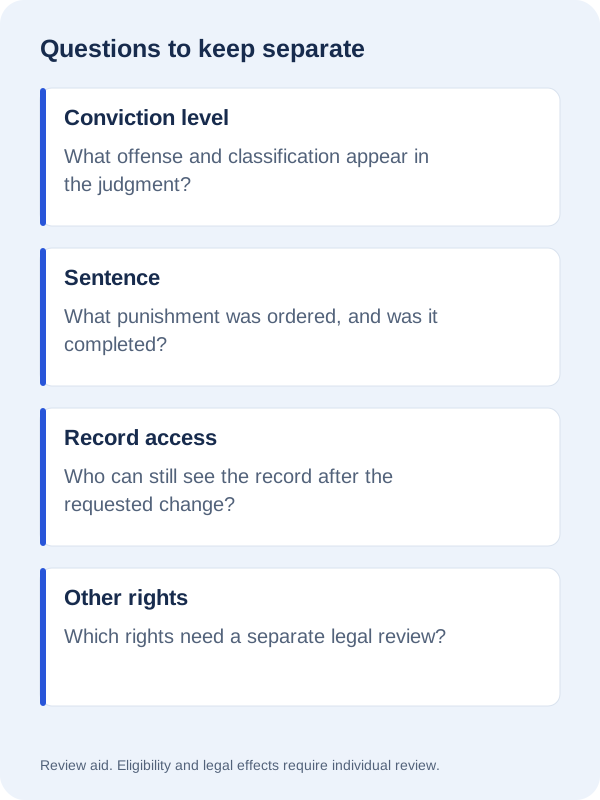
Read the diagram as text
- Conviction level
- What offense and classification appear in the judgment?
- Sentence
- What punishment was ordered, and was it completed?
- Record access
- Who can still see the record after the requested change?
- Other rights
- Which rights need a separate legal review?
Common question
Can I pursue both reduction and record relief?
Possibly, where the state law and case facts support separate routes. The availability, sequence and effects require individual review.
Official resources
Consult the issuing authority for current forms and local procedure.
- Utah Courts conviction reduction guidancewww.utcourts.gov
- Utah Courts adult expungement guidancewww.utcourts.gov
- California Courts — Record-cleaning indexwww.selfhelp.courts.ca.gov
- California Courts — Felony convictions and Proposition 47www.selfhelp.courts.ca.gov
- California Penal Code section 17leginfo.legislature.ca.gov
- Idaho Legislature: amendment of judgment under section 19-2604legislature.idaho.gov