
Identify the change being requested
Find the original judgment and any amended judgment. Record the existing conviction level and the result you want reviewed. Avoid using reduction to mean both a shorter sentence and a lower offense classification.
Check for a state-specific route
California's court guide discusses felony reduction, while Utah provides guidance on motions to lower conviction degree. Those examples do not establish availability in another state.
Plan the follow-up
If an order is entered, retain it and verify that the appropriate criminal-history record reflects the change. Then assess any separate sealing or expungement question using the amended record.
A way to organize your review
Questions to keep separate
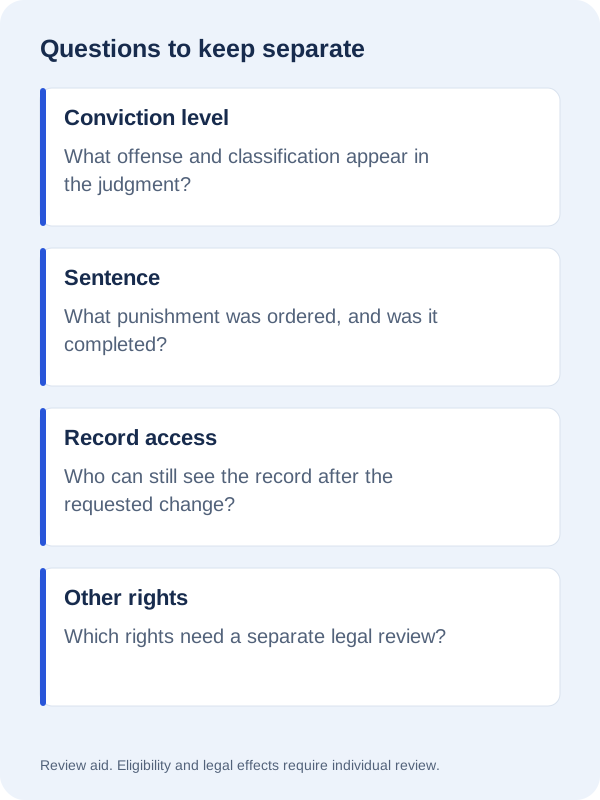
Read the diagram as text
- Conviction level
- What offense and classification appear in the judgment?
- Sentence
- What punishment was ordered, and was it completed?
- Record access
- Who can still see the record after the requested change?
- Other rights
- Which rights need a separate legal review?
Common question
Is reduction the same as expungement?
They address different legal questions. A change in conviction level does not by itself establish that the case has been expunged.
Official resources
Consult the issuing authority for current forms and local procedure.
- California Courts — Record-cleaning indexwww.selfhelp.courts.ca.gov
- California Courts — Felony convictions and Proposition 47www.selfhelp.courts.ca.gov
- California Penal Code section 17leginfo.legislature.ca.gov
- Utah Courts conviction reduction guidancewww.utcourts.gov
- Utah Courts adult expungement guidancewww.utcourts.gov
- Idaho Legislature: amendment of judgment under section 19-2604legislature.idaho.gov