
Start with the case outcome
Find the final disposition for each charge. An arrest without a conviction, a dismissal after a program, and a conviction can lead to different applications. A background report may leave out the document that explains the outcome.
Ask what the order changes
Before applying, identify which records the remedy covers and who may still obtain them. Ask separately about court records, police records, the state criminal-history repository and private background reports. Do not treat the word expungement as a promise that every copy disappears.
Use the law for the case state
The state where the case was handled usually provides the starting point for a state-court record. Moving to another state does not turn the old case into a new state's case. Federal and tribal cases need their own review.
A way to organize your review
Gather the facts behind the question
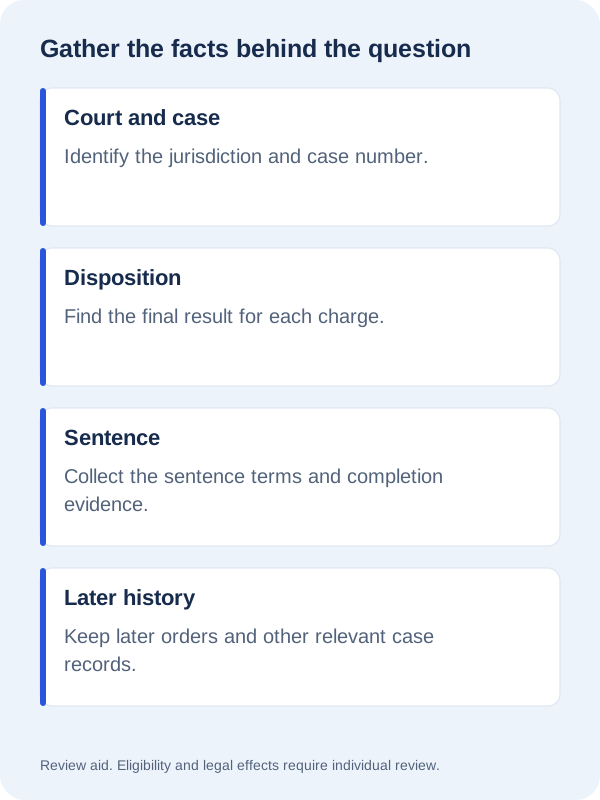
Read the diagram as text
- Court and case
- Identify the jurisdiction and case number.
- Disposition
- Find the final result for each charge.
- Sentence
- Collect the sentence terms and completion evidence.
- Later history
- Keep later orders and other relevant case records.
Common question
Does expungement erase every record?
The answer depends on the particular remedy. Read the order and the governing law before deciding what remains accessible or how to answer a disclosure question.
Official resources
Consult the issuing authority for current forms and local procedure.
- Utah Courts conviction reduction guidancewww.utcourts.gov
- Utah Courts adult expungement guidancewww.utcourts.gov
- California Courts — Record-cleaning indexwww.selfhelp.courts.ca.gov
- California Courts — Felony convictions and Proposition 47www.selfhelp.courts.ca.gov
- California Penal Code section 17leginfo.legislature.ca.gov