
Start with the judgment and sentence
Collect the offense statute, conviction level and sentencing record. Include probation or parole outcomes and later orders. Those documents help identify which reduction provision, if any, merits review.
Keep the state examples separate
California Penal Code section 17(b) and Utah's conviction-degree procedures use different requirements. A successful application described in one state is not a checklist for another.
Ask what remains after reduction
Review record access and the consequence you care about after determining the possible classification change. Immigration, firearms and licensing effects need their own advice.
A way to organize your review
Questions to keep separate
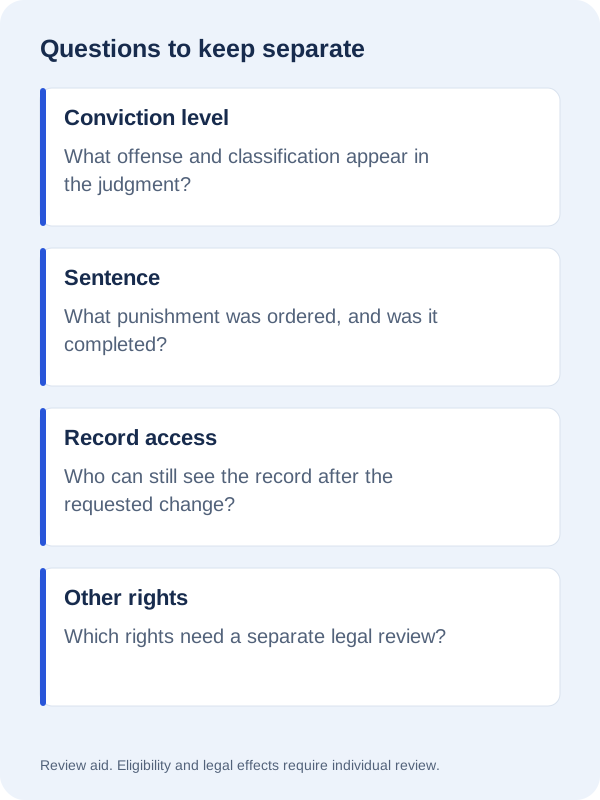
Read the diagram as text
- Conviction level
- What offense and classification appear in the judgment?
- Sentence
- What punishment was ordered, and was it completed?
- Record access
- Who can still see the record after the requested change?
- Other rights
- Which rights need a separate legal review?
Common question
Will a reduced felony disappear from a background check?
Reduction alone does not establish removal from a report. Check the order's effect, the updated record and any separate access remedy.
Official resources
Consult the issuing authority for current forms and local procedure.
- California Courts — Record-cleaning indexwww.selfhelp.courts.ca.gov
- California Courts — Felony convictions and Proposition 47www.selfhelp.courts.ca.gov
- California Penal Code section 17leginfo.legislature.ca.gov
- Utah Courts conviction reduction guidancewww.utcourts.gov
- Utah Courts adult expungement guidancewww.utcourts.gov
- Idaho Supreme Court — Clean Slate Actisc.idaho.gov
- Idaho Legislature: amendment of judgment under section 19-2604legislature.idaho.gov
- Idaho Supreme Court: treatment court rules and judgment reliefisc.idaho.gov