
Name the record
Identify whether you mean the court file, an agency criminal-history record or a commercial report. Keep a copy or reference number so the issue can be traced.
Read the access rules
Ask who can obtain a sealed record and for what purpose. An exception relevant to a license application may matter even when ordinary public searching is restricted.
Verify the result
After an order, follow the instructions for agency updates. Keep the order and check the relevant record. If something remains visible, establish whether it is covered before deciding how to respond.
A way to organize your review
Define the record-access question
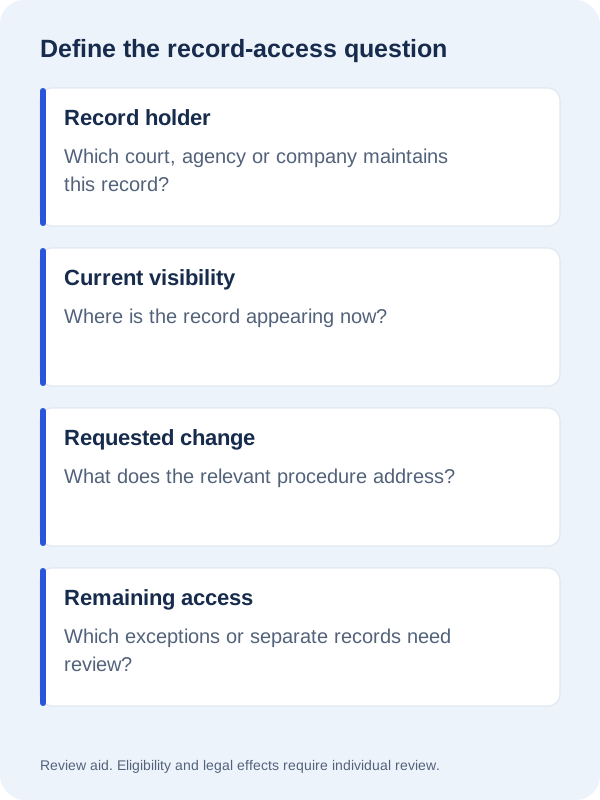
Read the diagram as text
- Record holder
- Which court, agency or company maintains this record?
- Current visibility
- Where is the record appearing now?
- Requested change
- What does the relevant procedure address?
- Remaining access
- Which exceptions or separate records need review?
Common question
Does sealing change the conviction itself?
The legal effect depends on the remedy. Review classification, dismissal and access as separate questions rather than assuming one change accomplishes all of them.
Official resources
Consult the issuing authority for current forms and local procedure.
- Nevada Parole and Probation — Sealing criminal recordsnpp.nv.gov
- Massachusetts chapter 276 section 100Amalegislature.gov
- New York CPL §160.57 — Automatic sealingwww.nysenate.gov
- New York Courts — Sealing after 10 yearswww.nycourts.gov